


News & Insights
Home| News & Insights| Case Study| From first cut to final frame: How New Era Informatique Partnered with Future Works Media to Build India’s First Fully Centralized Motion Picture Sound Workflow

From first cut to final frame: How New Era Informatique Partnered with Future Works Media to Build India's First Fully Centralized Motion Picture Sound Workflow

From first cut to final frame: How New Era Informatique Partnered with Future Works Media to Build India's First Fully Centralized Motion Picture Sound Workflow

How FutureWorks Media, Dell Technologies, and New Era Informatique are raising the bar for post-production across feature films, streaming originals, and series.

The Studio
Behind the screen

Mumbai is the beating heart of India’s entertainment industry. From Bollywood blockbusters to globally streamed originals, the content that captivates audiences across continents is conceived, crafted, and consigned here. At the centre of that finishing process, trusted by Netflix, Prime Video, HBO, Dharma Productions, and Yash Raj Films, is FutureWorks Media Group.

Led by Co-Founder and CEO Mr Gaurav Gupta, FutureWorks Media offers “set to screen” production services across colour, visual effects, and sound, working on feature films, streaming originals, and series for Indian and international audiences alike. Over 2,000 projects have moved through its studios, from Bollywood tentpoles to award-winning global content. More than 400 artists and technologists deliver this across Mumbai, Chennai, and Hyderabad. Delivering at this scale calls for more than creative talent. Video resolutions keep climbing, release windows keep tightening, and the technical foundation has to keep pace.


Solutions
Challenge
Gap between the art and the infrastructure

As cinema and streaming moved through each new resolution benchmark, and as Dolby Atmos and Dolby Vision became the mastering standard, along with AI entering production pipelines, file sizes on every project grew roughly tenfold in a decade. Three-year capacity plans were being crossed in half the time.

In a Dolby sound mix session, a single track can run into gigabytes, and projects routinely span hundreds of tracks. Across the industry in India, sound has historically been handled by individual drives plugged directly into workstations, with files being run physically between rooms. As creative ambition expanded, so did the opportunity to bring these workflows together on a unified, high-performance foundation.

Action
Assembling the crew

Mr Gupta’s brief to his infrastructure partner was driven by a clear ambition: bring sound, the most latency-demanding stage of all, fully onto central storage, and lift the wider environment to match. He turned to New Era Informatique, FutureWorks’ IT solutions partner for over a decade, with a mandate to centralise storage with controlled access, consolidate fragmented data into a single managed environment, upgrade network connectivity to remove transfer bottlenecks, and retain role-based security and compartmentalisation across departments and cities.

Founded in 2001 by Mr Dinesh Ochani, New Era Informatique is a Dell Technologies Titanium Tier partner specialising in infrastructure for media and entertainment and other industries. The firm had made an early, deliberate bet on Dell PowerScale, building an in-house team of certified engineers, and later adding Dell switch certifications, well ahead of the market.

For the terabytes of unstructured data that media post-production generates, PowerScale was the clear option. While other platforms cap single volumes at 256TB to a petabyte, PowerScale presents a single namespace up to 20PB, with all-flash NVMe architecture delivering 8 to 10 GB/s of throughput.

As the global standard for media workloads, it lets teams edit directly on centrally stored data. For the audio studios, where latency tolerances are narrowest, the specific node line is PowerScale F600, an all-flash platform carrying the Dolby mixing, recording, foley, and full-size theatre environments together.

The architectural call was just as deliberate. Storage, networking, and workstations all came from Dell Technologies, a single OEM simplifying the support chain. On top of this, FutureWorks has built its own high-speed data movement engine, FastX, which orchestrates priority datasets between sites over a secure IPSEC-VPN, inside a private-cloud architecture that keeps every location independent of external cloud dependency.

Setup
Rolling the camera

The groundwork began in the audio edit rooms and mix suites, not in the data centre. Before any hardware arrived, the New Era Informatique team sat with FutureWorks' department heads and creative leads, mapping how data moved through various sound departments, and what an unblocked workflow would feel like. Planning ran right down to VLAN design, workstation connectivity, and whether quota allocation should be user-based or group-based by department. Those conversations, not a spec sheet, called the shots.

The same rigour was applied to the VFX division, analysing its unique storage and workstation requirements for performance, business continuity, scale, reliability, and multi-city file movement via FastX. Workstation specifications, storage tiering, and network paths were each mapped to how a VFX shot actually moves, from plate ingest through to final composite. That mapping translated into a defined storage footprint: 1 Petabyte of PowerScale Hybrid Nodes and 1 Petabyte of Archival Nodes in Mumbai, and a further 1 Petabyte Hybrid Nodes cluster in Chennai.

Equipment
What was deployed

3 ×
Dell PowerScale Storage(one per site), including F600 all-flash nodes powering the audio studios

50 ×
Dell Precision workstations, high-GPU configuration for Modern AI Workflows

8 ×
Dell PowerSwitch Ethernet Data Centre Switches (10-Gigabit), replacing legacy 1 Gigabit network

Climax
After the cut

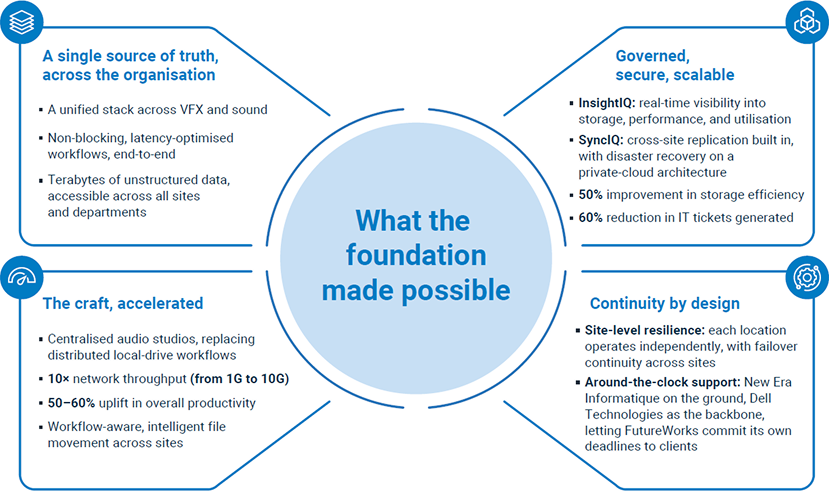
FutureWorks became the first studio in India to move its motion picture sound workflow entirely onto central storage. The proof point arrived with Border 2, one of the most anticipated tentpole releases of the year, where the full sound mix ran off centralised Dell PowerScale. Main mix stages and supporting editorial rooms drew from a single source, collaborating in real time on a track count that few Indian studios have ever handled, and on a deadline that left no room for a second take.

That same Dell PowerScale foundation now carries Sound and VFX across FutureWorks, tuned to each craft.

Sound sits on F600 all-flash, where latency tolerances are narrowest. VFX runs on its own PowerScale tier, sized for the throughput and capacity that shot work demands. What both departments share is the layer underneath: a common PowerScale family, a unified 10G network, FastX moving priority datasets between Mumbai, Chennai, and Hyderabad, and a single identity and security model across all three.

When a regional festival or local disruption takes one city off-cycle, work shifts across locations without production breaking stride. When a project lands on a rescue timeline, the same architecture absorbs the ramp-up rather than buckling under it. For sound and VFX, the infrastructure has stopped being something the studio works around and started being something it works through.

The sequel

The road ahead rests on four pillars: a resilient foundation, scale-out storage, continued investment in network speed, and readiness for AI-era workloads already reshaping production. New nodes can be added without downtime, and new locations can join the synchronised fabric without requiring a rebuild. The whole platform runs as one integrated Dell Technologies setup, backed by a single partner relationship with New Era Informatique.

Looking ahead, FutureWorks remains focused on evolving the craft, applying technology in new ways. Mr Gupta is firm that this ambition will continue to guide the studio. That posture, and a platform built to grow with it, is what carries every project, every language track, and every format all the way to the final reel.

https://youtu.be/aXODIde9orE?si=8fsl3HH3pmcQeDS0

Welcome to New Era.
How can we help.

    Get in Touch